
Systems · 2 min · 17.11.2026
Work lives between the systems

Kim Lehtola
Operations Designer, Topliner
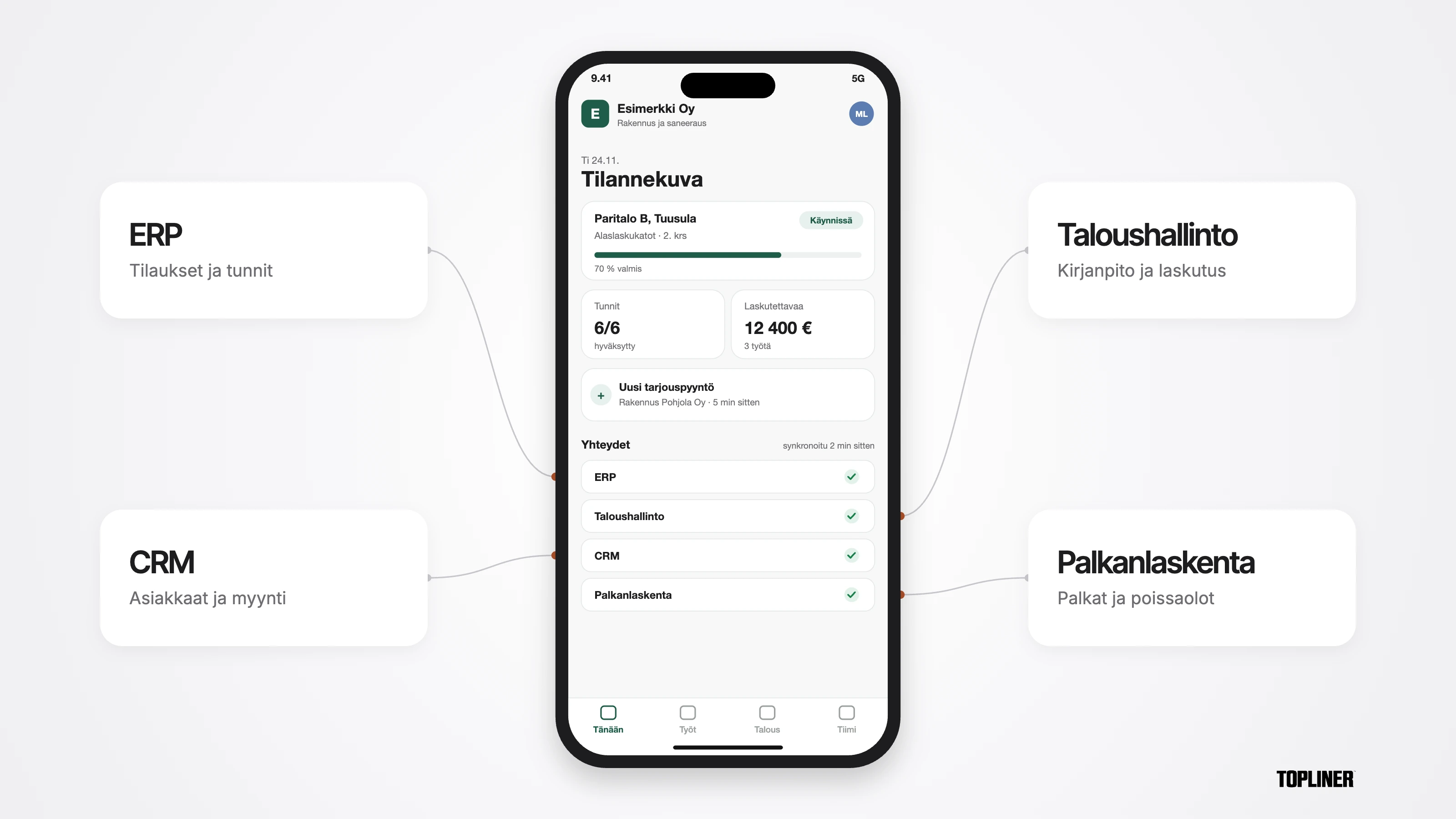
Every system does its own job well. The ERP handles orders and time records, the accounting system bookkeeping and invoicing, the CRM customers and sales. Each is built for its task and that's where it's at its best.
But off-the-shelf solutions are made for thousands of companies, so the company has to adapt to them. Eventually the core of everyday work starts to run between the systems. Everything that doesn't fit into any one system is handled in between. Information moves between them through people: copying, messaging and spreadsheets, whatever works at the time.
The gaps are invisible
A quote is created in Word or Excel and the order is entered into the ERP. Sales are reported in spreadsheets and the financial figures are usually seen only afterwards. Nobody owns the gaps between systems. They don't appear in the org chart or in any system's reports. Yet that's exactly where delays, errors and unbilled work arise.
As the company grows, the gaps multiply. Every new system solves its own problem and creates a new gap.
Operations Design designs the gaps
Operations Design doesn't necessarily replace existing systems. It designs the everyday work that runs between them: who does what, where information is created and where it needs to end up.
The app connects to your existing systems. Information is entered once and moves on by itself: from the site to payroll, from quote to order and from finished job to invoice. The ERP, accounting and CRM get the right information at the right time, and everyday work gets a tool made for it.
Do you know where your everyday work passes from one system to another through people?
Let's go through it in an operations review.
Book an operations review