Technology · 3 min · 25.11.2026
Off-the-shelf software sells a tool. Operations Design sells work that works.

Kim Lehtola
Operations Designer, Topliner
When software became a service
Software as a service (SaaS) changed how software is bought. Instead of licences and your own servers, you pay a monthly fee and the software runs in the browser. It put good tools within everyone’s reach.
But the model comes at a price. The same software is sold to thousands of companies, so it is by necessity built for the average. When the software and your way of working don't match, the company adapts. In the field, people fill in fields nobody uses. In the office, information is moved from one system to another. And when you have five off-the-shelf systems, everyday work starts to live in the gaps between them: in spreadsheets, emails and message threads.
A service that works as software
Service as software (SaS) turns the idea around. Software no longer sells a tool you use to do the work yourself. It does part of the work and delivers the result. Not a reporting tool, but a finished report. Not a time-tracking system, but payroll data that’s ready at month-end.
AI made this possible. Building software has become so much faster that an app can be built for one company's needs in a matter of weeks.
First you need to know what to build
Here's the trap. When building is easy, you can build the wrong thing fast. Move today's mess into an app and you get a faster mess.
That's why Operations Design starts with everyday work, not with the app. First we find out how work really flows in your company. Who does what, how information moves and where work gets stuck. Then we design how it should flow. Only then is an app built to make it real, and it evolves as your work changes.
First the work. Then the tool. Code is a commodity. Understanding how work really works is not.
Off-the-shelf software isn't going away
This doesn't mean the era of off-the-shelf software is over. Accounting, payroll and ERP systems can keep doing what they do best: bookkeeping, statutory calculations and storing data reliably.
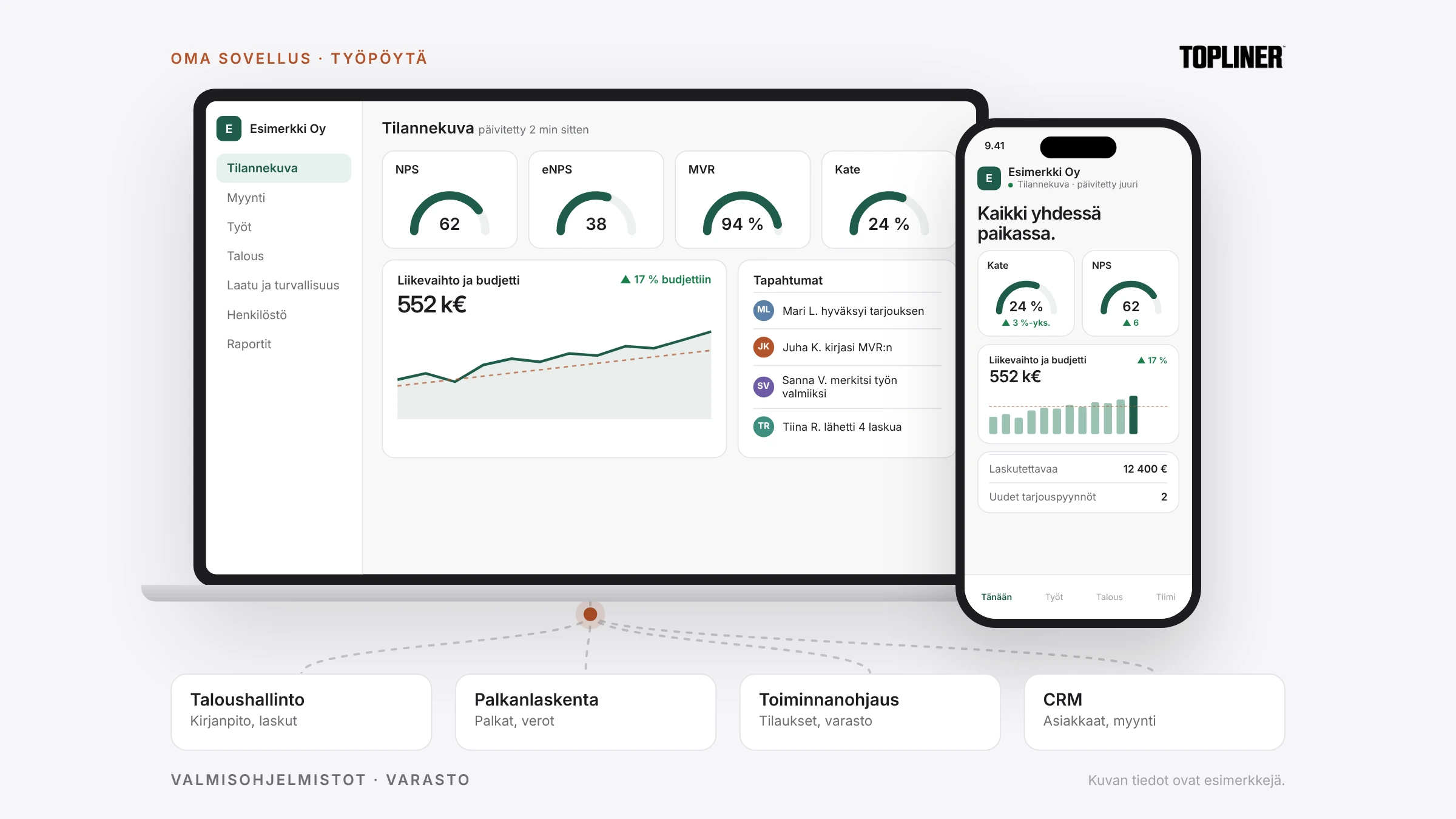
Their role does change, though. They move into the background, and everyday work happens in a layer on top of them. Your own app brings the work into one view and sends information automatically to where it belongs. Nobody in the field opens five systems, yet the information still ends up in each of them.
Off-the-shelf software is the warehouse. Your own app is the workbench.
Your own system is now for everyone
Just a few years ago, your own system was a big-company advantage. It took a software house, a year-long project and a budget no small business could afford. Now the same is within reach of a fifteen-person construction firm, at a fraction of what it used to cost.
The question is no longer whether you can afford your own system. It's whether you can afford to keep adapting.
How much of your everyday work has adapted to your software?
Let's go through it in an operations review.
Book an operations review